A Flexible Layer for Hospitality Design
Guest rooms and shared spaces need to feel welcoming without exposing every activity to view. PDLC (Polymer Dispersed Liquid Crystal) glass offers a way to change visual privacy without adding curtains to each opening. For New York hotels, restaurants and spas, its value lies in making a fixed glass surface serve different moments of the day.
Giving Guests Understandable Privacy Controls
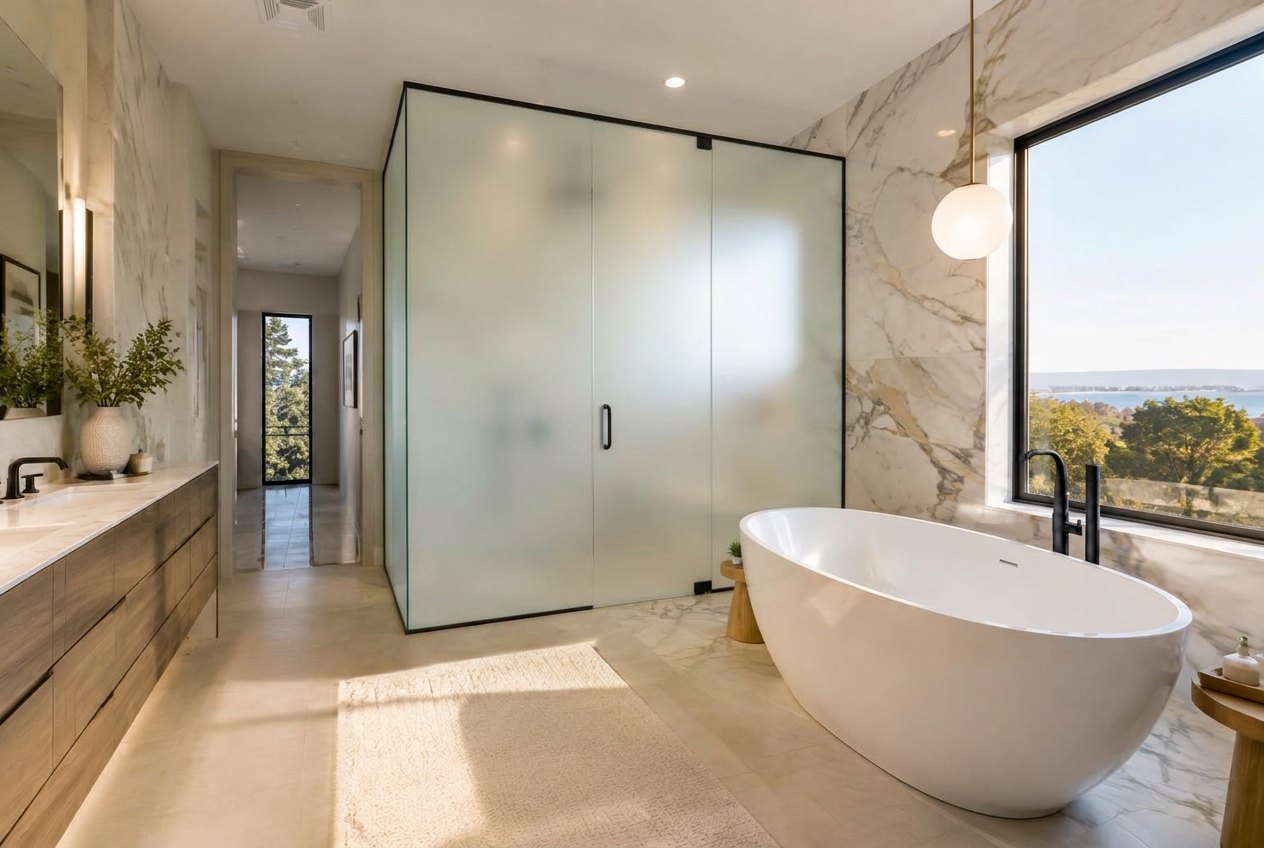
A bathroom partition can remain clear when the room is unoccupied and turn frosted when a guest wants seclusion. Standard PDLC uses electricity to align liquid crystals for clear operation and becomes frosted when power is removed. Keep the switch easy to identify, and test lighting and sightlines before relying on the panel for guest privacy.
Products may block up to 99% of UV rays, subject to the selected specification. That figure should not be read as a promise of equivalent heat or glare reduction. In a busy Midtown property, acoustic privacy also requires an appropriate glass and wall assembly; PDLC film alone does not make a partition soundproof.
Integrating Glass with the Interior Palette
Switchable glazing can be considered for room dividers, doors and other suitable glass features. A boutique Brooklyn interior might pair it with warm finishes, while a contemporary lobby might use slim metal framing. Specify the actual panel, controls and installation conditions rather than treating every opening as interchangeable.
The transition itself can become a restrained design detail, revealing a display behind glass or changing the mood of a private dining area. Pairing the panel with wood, metal or stone keeps the technology connected to the rest of the room. These are design possibilities, not claims about completed installations.
Creating Adaptable Guest-Facing Spaces
A spa consultation room or a private lounge can feel visually connected when clear and more secluded when frosted. Touch controls require compatible hardware, and interactive screens are separate systems. Switching the glass changes visibility through the panel; it does not generate a different view or display information by itself.
For events, a glass meeting enclosure can offer visual privacy during a presentation and reopen sightlines for a reception. Compatible projection equipment may allow use of a frosted surface for content, but that requires its own design and testing. Film alone does not create digital signage.
Looking Beyond Energy-Saving Claims
Replacing selected curtains may simplify the material palette and routine care, but a responsible environmental comparison includes film, glass, controls and service life. Hotel heating and cooling performance depends on the complete building envelope. For a New York or Hamptons hospitality project, assess solar control separately from the privacy function.