
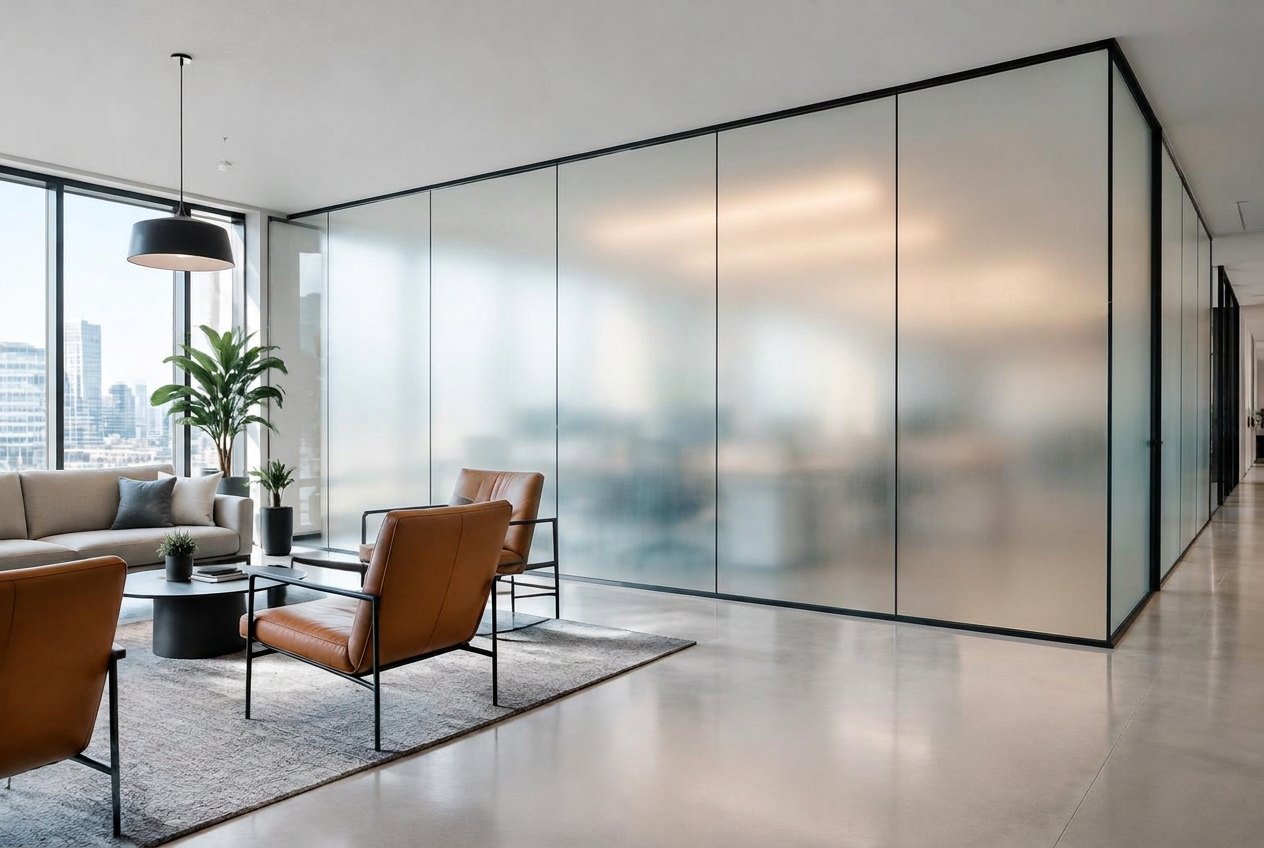
Can smart glass deliver 100% privacy? For New York rooms facing neighbors, corridors or shared work areas, the answer needs more detail than a simple yes. PDLC glass changes from clear to frosted, obscuring the view while still admitting diffuse light.
Frosted does not mean blackout. Strong backlighting, a person standing close to the panel and viewing angle can make silhouettes visible. Film choice, coverage and the lighting on each side all influence the result.
PDLC stands for polymer dispersed liquid crystal. With power applied, the liquid crystals align so more light passes directly through; without power, they scatter light to create the frosted appearance. Correct controls and installation support consistent operation.
For a bedroom facing a nearby building or a consultation room opening onto a hallway, test a sample under realistic lighting. A privacy demonstration is more useful than an absolute promise.
Surface-applied smart window film can upgrade suitable existing glass. Neat edge coverage and careful fitting matter, particularly around frames where an uncovered gap could preserve a sightline.
Laminated switchable glass encloses the PDLC layer within the glazing assembly. It can suit new partitions or replacement panels, but it does not automatically provide greater visual privacy than every retrofit film; compare the actual products and viewing conditions.
The term smart tint can describe different technologies. The electrically controlled PDLC film discussed here is not a light-activated tint, and its frosted state should not be confused with a dark solar-control window.
Smart glass can offer useful visual separation, but it is not a 100% guarantee against silhouettes in every setting. Smart Glass New York can help assess sightlines and lighting for projects across New York, New Jersey and Philadelphia.